
For a commercial building, an HVAC failure is not a comfort problem. It is a trading problem. A restaurant cannot serve, a retail floor empties, a medical suite reschedules, and a tenant starts asking questions about the lease. The equipment itself is rarely the largest cost in that sequence.
Commercial systems also fail differently to residential ones. They run far longer hours, they sit exposed on a roof through a Rochester winter, and a single rooftop unit often carries the entire load for a zone with no backup. The maintenance model that suits a house does not transfer.
This guide sets out what commercial HVAC maintenance actually covers, how often equipment should be serviced, what a service agreement should contain before you sign it, and what it costs in this area.
From Darren, the owner
The commercial calls that go badly are almost always the ones where nobody has been on the roof in two years. Belts, filters and drains are cheap while they are still belts, filters and drains. What they turn into is a compressor in August with a queue of customers waiting.
What Commercial HVAC Maintenance Covers
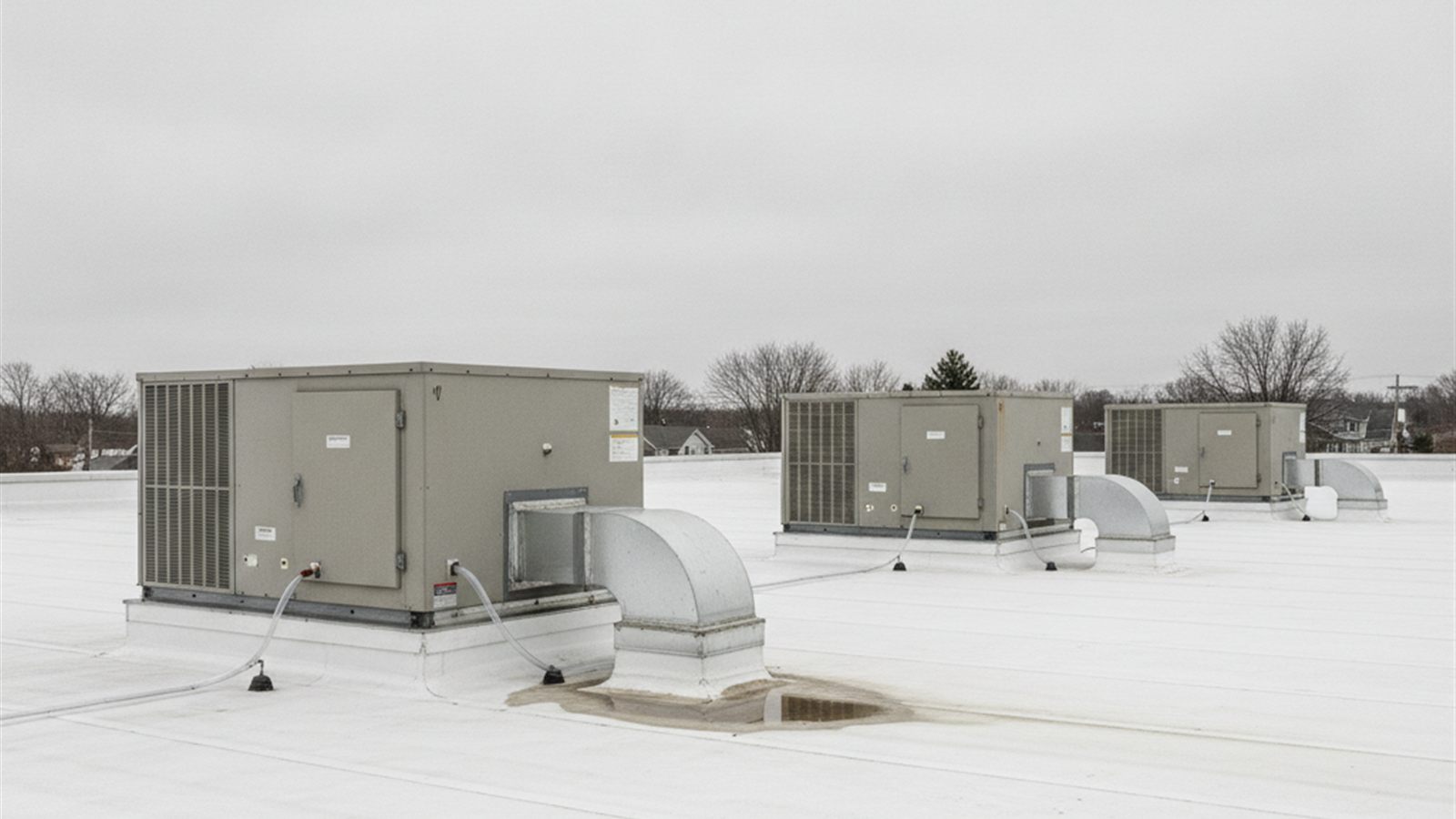
Most small and mid-sized commercial premises in Greater Rochester run rooftop package units, commonly abbreviated to RTUs. Each unit contains the compressor, condenser, evaporator, blower and, in most cases, a gas heat section, all in one weatherproof cabinet. Larger buildings run split systems with indoor air handlers and separate condensers, and some older properties still run boilers with air handling units.
Maintenance covers the same functional areas regardless of configuration.
The functional areas covered
- Airside: filters, belts, blower bearings, economiser dampers and linkages
- Refrigeration: charge verification, coil condition, superheat and subcooling readings
- Electrical: contactors, capacitors, terminal tightness, amp draw against nameplate
- Heating: burner condition, heat exchanger inspection, flue integrity, safety interlocks
- Drainage: condensate pans, traps and lines, which fail more often on flat roofs than anywhere else
- Controls: thermostat and building management setpoints, schedules, sensor calibration
Why Commercial Equipment Fails Differently
Three differences drive the whole maintenance case, and they explain why a residential schedule underserves a commercial building.
| Factor | Residential system | Commercial rooftop unit |
|---|---|---|
| Annual run hours | Roughly 1,500 to 2,500 | Commonly 4,000 or more |
| Location | Basement or side of the house, sheltered | Exposed roof, full weather and UV load |
| Redundancy | None, but failure is a comfort issue | Usually none, and failure stops trading |
| Filter loading | Household dust | Higher occupancy, cooking, retail dust, print and workshop particulate |
| Access | Immediate | Roof access, sometimes requiring equipment or permits |
| Typical service life | 15 to 20 years | 10 to 15 years, shorter under heavy load |
The run-hours figure is the one that surprises building owners. A rooftop unit serving a seven-day retail operation accumulates in three years what a house accumulates in seven. Belts and bearings wear on hours, not calendar years, which is why an annual visit that suits a home leaves a commercial unit unattended for the equivalent of two or three residential seasons.
What a Preventive Maintenance Visit Includes
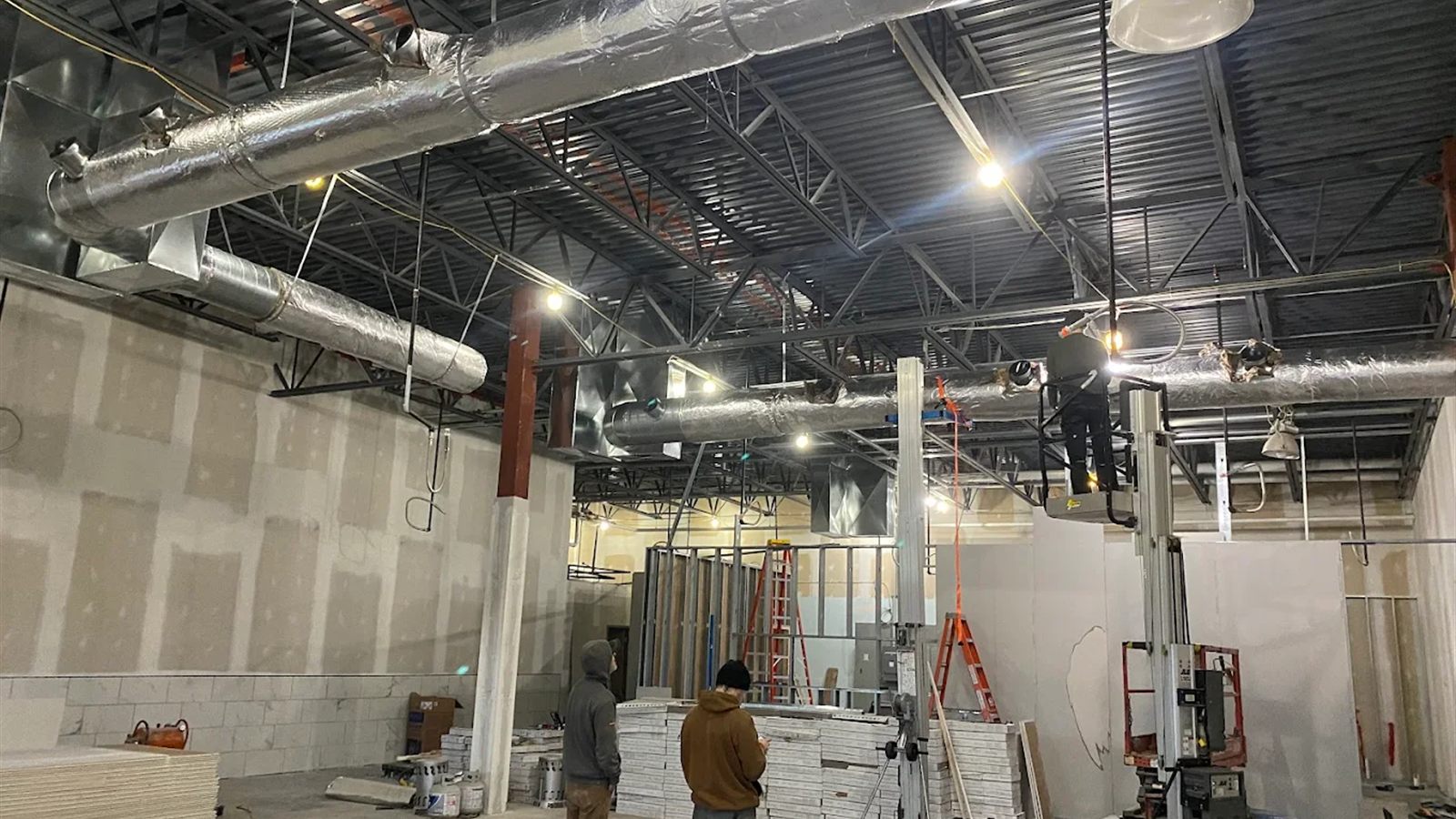
A preventive visit is seasonal rather than generic. The cooling changeover and the heating changeover check different systems, and a agreement that does not distinguish between them is not doing the job.
| Task | Spring, cooling changeover | Autumn, heating changeover |
|---|---|---|
| Replace filters, record sizes and quantities | Yes | Yes |
| Inspect and tension or replace drive belts | Yes | Yes |
| Clean condenser and evaporator coils | Yes | Inspect |
| Verify refrigerant charge, superheat and subcooling | Yes | No |
| Clear condensate pan, trap and drain line | Yes | Inspect |
| Inspect heat exchanger and burners | No | Yes |
| Test safety controls and limit switches | Yes | Yes |
| Check contactors, capacitors and amp draw | Yes | Yes |
| Exercise economiser dampers and linkages | Yes | Yes |
| Confirm control schedules and setpoints | Yes | Yes |
The heat exchanger inspection in the autumn visit carries a safety dimension the others do not. A cracked exchanger on a gas-fired rooftop unit can introduce combustion products into the supply air, which is why that inspection should be documented rather than simply ticked. Where a unit is found to have a compromised exchanger, it is taken out of service rather than scheduled for later attention.
How Often Commercial Systems Should Be Serviced
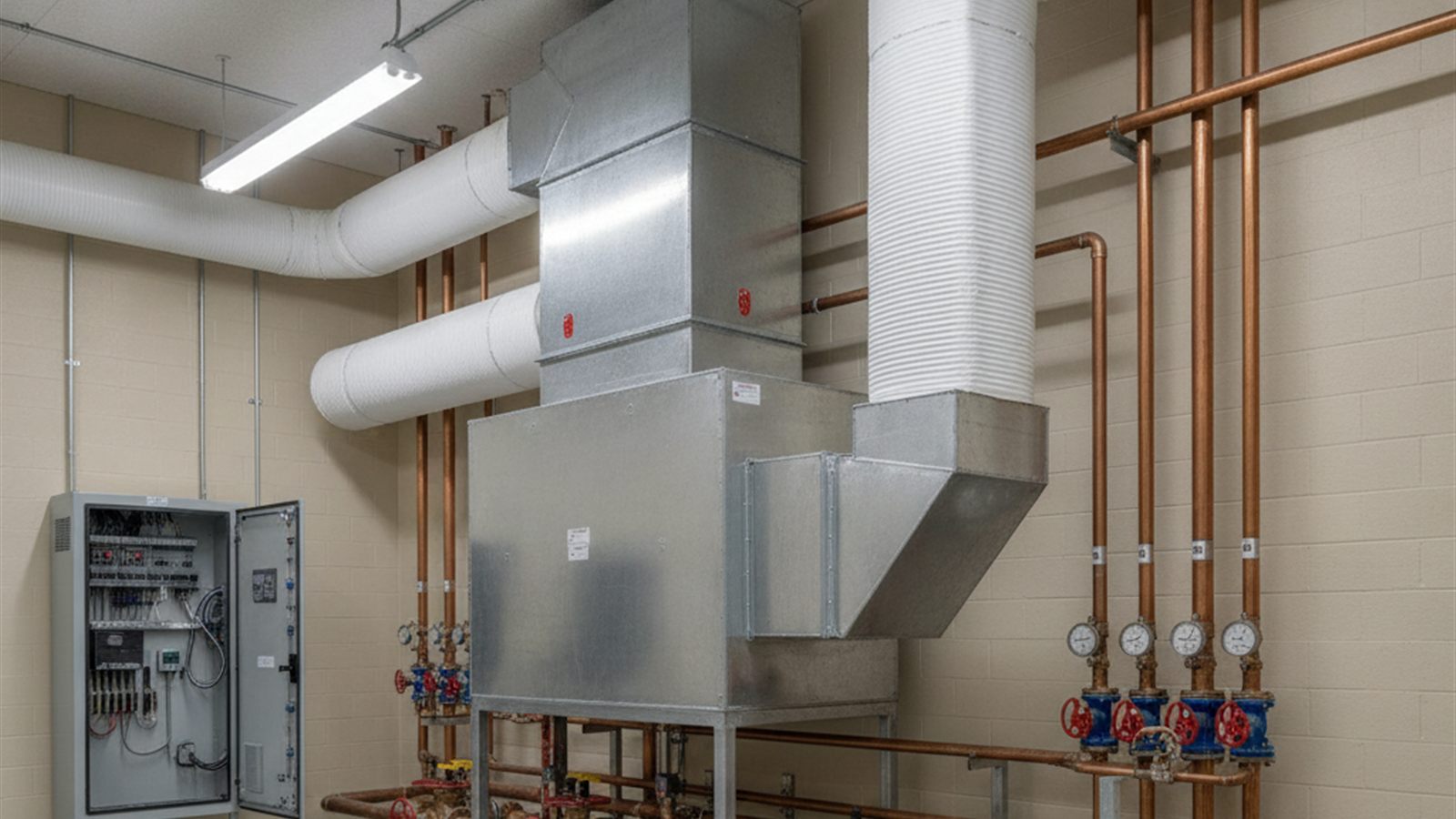
Frequency should follow load and environment rather than a single default. The table below reflects what we recommend for premises in this region.
| Premises type | Recommended visits per year | Filter changes per year | Driver |
|---|---|---|---|
| Professional office, standard hours | 2 | 2 to 4 | Predictable load, low particulate |
| Retail, seven-day trading | 2 to 3 | 4 | Extended run hours, door traffic |
| Restaurant or food service | 4 | 6 to 12 | Grease loading, makeup air, high heat |
| Medical or dental | 4 | 4 to 6 | Air quality requirements, humidity control |
| Light industrial or workshop | 3 to 4 | 6 to 12 | Airborne particulate |
| Warehouse, heating only | 1 to 2 | 2 | Lower cooling load, seasonal heating |
Restaurants sit at the top of that range for a reason. Grease-laden air degrades filters, coats evaporator coils and shortens belt life faster than any other commercial environment, and makeup air units add a second system with its own schedule. A quarterly interval is not conservative in that setting, it is the minimum that keeps units running through a summer.
What a Service Agreement Should Contain
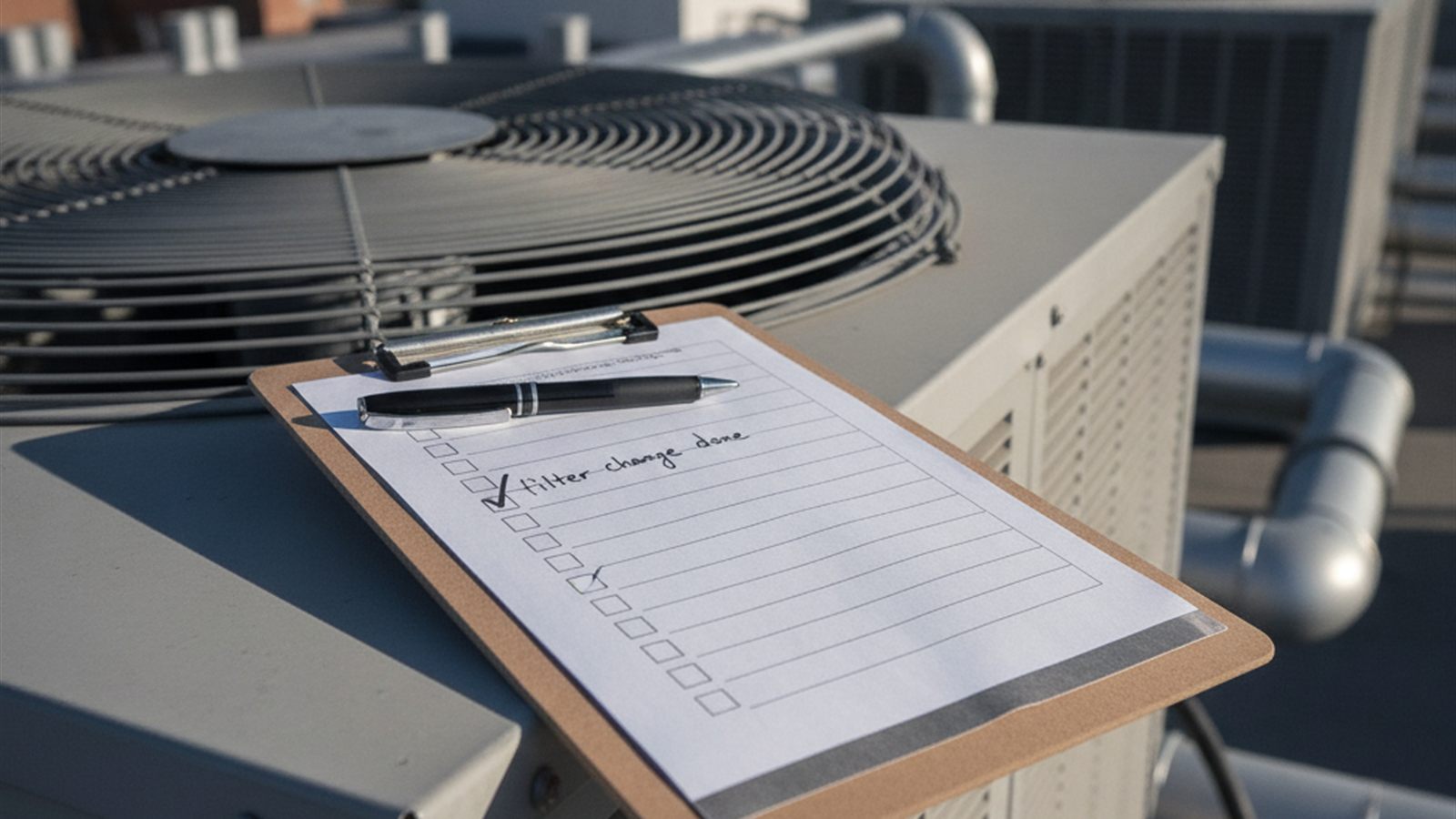
Agreements vary widely in what they actually commit to. Several clauses are worth confirming in writing before signing, because their absence is what turns a maintenance contract into a subscription that delivers very little.
Confirm these before signing
- Equipment schedule. Every unit listed by location, make, model and serial, not “all rooftop equipment”
- Task list per visit. What is actually performed, seasonally differentiated
- Filters included or excluded. Often excluded and billed separately, which materially changes the annual figure
- Written report per visit. Readings recorded, not just a signature
- Response time for breakdowns, with separate figures for business hours and out of hours
- Labour rate for repairs falling outside the agreement, and whether agreement holders receive priority scheduling
- Refrigerant handling. Whether charge is included and how leak repairs are quoted
The written report clause matters more than it appears. A documented history of readings is what allows a failing compressor or a drifting charge to be identified before it stops the building, and it is the evidence base for deciding between further repair and replacement later. Our approach to preventive HVAC maintenance is built around that record rather than a visit count.
Commercial Maintenance Costs in the Rochester Area
Commercial pricing scales with unit count, tonnage and access. The ranges below are typical for small and mid-sized premises in this area and are confirmed in writing before any agreement begins.
| Service | Typical Rochester cost | Basis |
|---|---|---|
| Single preventive maintenance visit, per rooftop unit | $175 – $350 | Per unit, per visit |
| Twice-yearly agreement, per rooftop unit | $350 – $700 | Per unit, per year |
| Quarterly agreement, per rooftop unit | $650 – $1,300 | Per unit, per year |
| Commercial filters | $8 – $40 each | Varies by size and rating |
| Business-hours diagnostic call | $150 – $275 | Credited against the repair |
| Out-of-hours emergency call-out | $275 – $500 | Plus parts and labour |
| Rooftop unit replacement, 5 to 10 ton | $9,000 – $22,000 | Per unit, including crane where required |
Set the agreement cost against the replacement figure in the final row. A twice-yearly agreement on a five-unit building sits in the region of $1,750 to $3,500 annually. A single premature rooftop replacement, with crane hire and a curb adaptor, exceeds that several times over, before accounting for whatever the closed hours cost the business.
Emergency Cover and Response
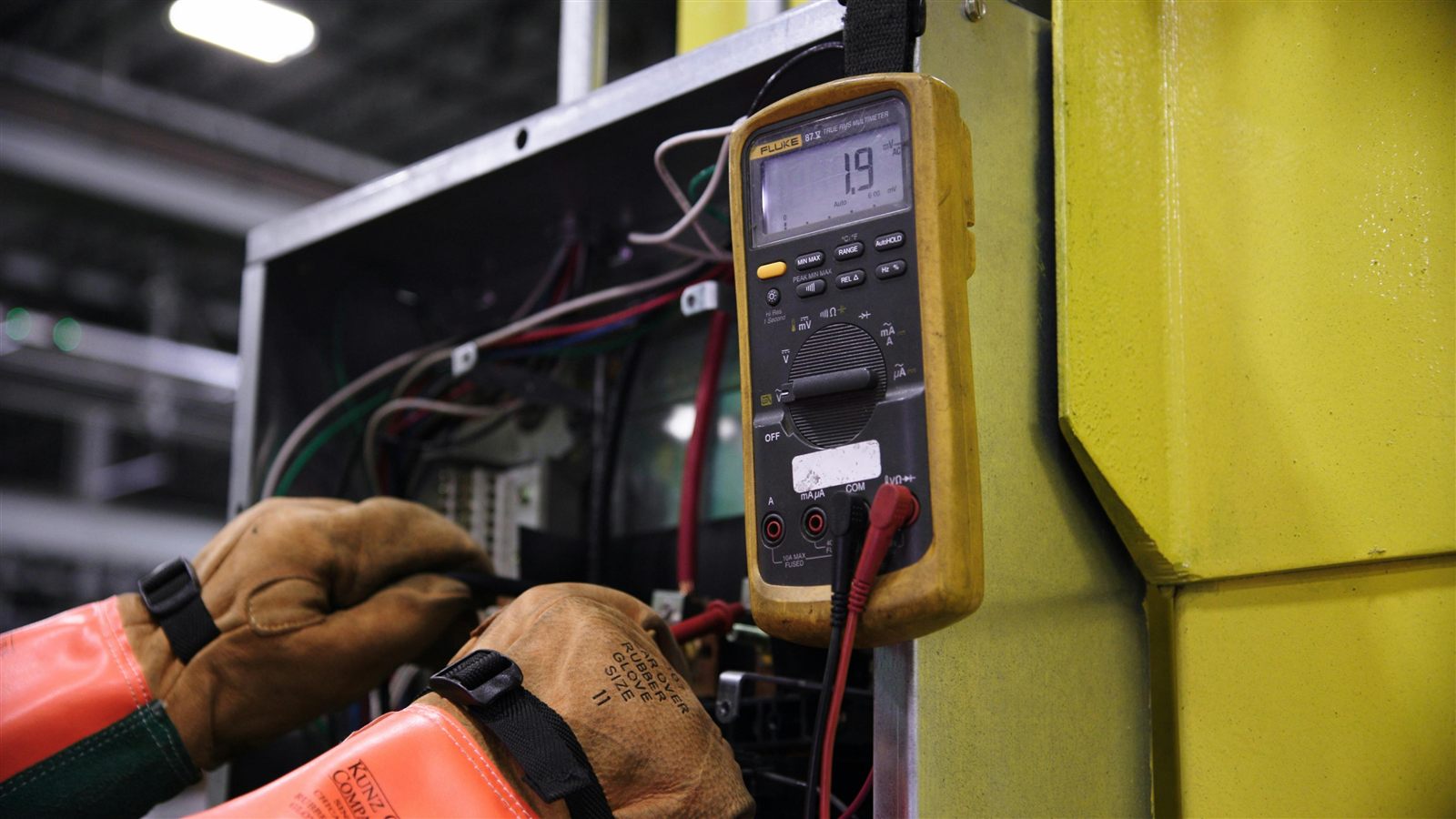
Two failure windows carry disproportionate cost in this climate. A cooling failure during a July heat wave and a heating failure during a January cold snap are both periods when every contractor in the region is already committed.
Parts availability is the constraint most owners underestimate. A commercial blower motor or a specific compressor is rarely a stock item, and a unit out of production can take a week or more to source. This is where a documented equipment schedule earns its cost, because a contractor who already holds the model and serial numbers can begin sourcing before attending. We answer 24/7 emergency HVAC calls across the region, and commercial agreement holders are scheduled ahead of general calls during peak periods.
“I’m a retail store owner. Our AC was not working on both of our RTU’s. Our other provider was struggling to give attention to us for a 2 week period, which is unacceptable being a 7 day a week retail store. Also no one could source the part without waiting at least a week for install. Within 24 hours Dalton had it resolved.”
Jared Roth ★★★★★
Google review, commercial rooftop unit repair
When Replacement Makes More Sense Than Maintenance
Maintenance extends service life. It does not extend it indefinitely, and there is a point at which continued spending on an ageing rooftop unit stops being economic.
Indicators that a unit should be priced for replacement
- Beyond 15 years of service, or beyond 12 under restaurant or industrial load
- Running on R-22, where refrigerant cost alone makes a significant leak uneconomic to repair
- Two or more unscheduled repairs within a single trading year
- A failed compressor or heat exchanger out of warranty
- Cabinet or base rail corrosion sufficient to compromise the unit’s weather integrity
- Replacement parts no longer manufactured or on extended lead time
Where two or more of these apply together, a replacement quotation is worth obtaining alongside the repair estimate so the comparison is made on numbers rather than urgency. Sound diagnosis is the same discipline behind our commercial HVAC repair across Greater Rochester, and we would rather tell a building owner a unit has three more seasons in it than sell a replacement that was not required.
We maintain commercial systems for offices, retail units, restaurants and light industrial premises across Victor, Pittsford, Fairport, Canandaigua, Farmington and the business parks around Henrietta, and have done since 1989.
Reviewing Your Commercial HVAC Cover?
We will survey the equipment on your roof, list it properly, and quote a maintenance schedule matched to how the building is actually used. No obligation, and we will tell you if your current arrangement is already adequate.
Family-owned Rochester HVAC since 1989, free over the phone, free in-home proposals, no upsell.
Frequently Asked Questions
Select a question to view the answer
How often should commercial HVAC be serviced?
Twice a year covers a standard-hours office. Seven-day retail generally needs two to three visits, and restaurants, medical premises and light industrial sites are better served quarterly. Frequency should follow run hours and airborne loading rather than a single default, since a rooftop unit on a seven-day operation accumulates in three years what a residential system accumulates in seven.
What is included in commercial HVAC maintenance?
A visit covers six functional areas: airside items such as filters, belts and blower bearings; refrigeration checks including charge, superheat and subcooling; electrical components such as contactors, capacitors and amp draw against nameplate; the heating section including burners and heat exchanger; condensate drainage; and control setpoints and schedules. Spring and autumn visits differ, since refrigerant verification belongs to the cooling changeover and heat exchanger inspection to the heating changeover.
How much does a commercial HVAC maintenance contract cost?
In the Rochester area a twice-yearly agreement typically runs $350 to $700 per rooftop unit per year, and a quarterly agreement $650 to $1,300 per unit. A single visit without an agreement is usually $175 to $350 per unit. Filters are frequently billed separately, which is worth confirming, since it materially changes the annual figure.
How long do commercial rooftop units last?
Ten to fifteen years is typical, against fifteen to twenty for residential equipment. The difference is run hours and roof exposure rather than build quality. Units under restaurant or light industrial loading sit at the lower end, and a maintained unit routinely outlasts an unmaintained one by several seasons.
Is a maintenance agreement worth it for a small business?
The calculation is straightforward. A twice-yearly agreement across five rooftop units sits around $1,750 to $3,500 a year. One premature rooftop replacement, including crane hire and a curb adaptor, runs $9,000 to $22,000 before counting lost trading hours. Agreements also carry priority scheduling during the July and January peaks, which is when availability matters most.
Do you provide emergency commercial HVAC service?
Yes, 24 hours a day across Greater Rochester. Parts availability is usually the real constraint rather than attendance, since commercial blower motors and compressors are rarely stock items. Where we hold a documented equipment schedule with model and serial numbers, sourcing can begin before the technician arrives on site.
Dalton Heating & Cooling
1556 Brace Rd, Victor, NY 14564
Office hours: Mon to Fri, 8:00 AM to 4:30 PM
Emergency service: 24/7 by phone