
A technician has given you a repair figure and mentioned that the system is getting on. The question that follows is always the same: is it worth fixing, or is that money better put toward a replacement?
It is a decision that gets made badly in both directions. Homeowners replace equipment that had years left because a single component failed, and others spend repeatedly on a system that should have been retired two summers earlier.
The decision comes down to four inputs: the age of the system, the cost of the repair in front of you, the refrigerant it runs on, and whether the furnace is due for replacement at the same time. This guide works through each with the numbers that apply in the Rochester area.
From Darren, the owner
Sometimes a $200 part is the right answer and sometimes it is throwing money at a system that owes you nothing. What decides it is not the age on its own. It is the age together with what has failed. A capacitor on a twelve-year-old unit is a repair. A compressor on the same unit usually is not.
Start With the Age of the System
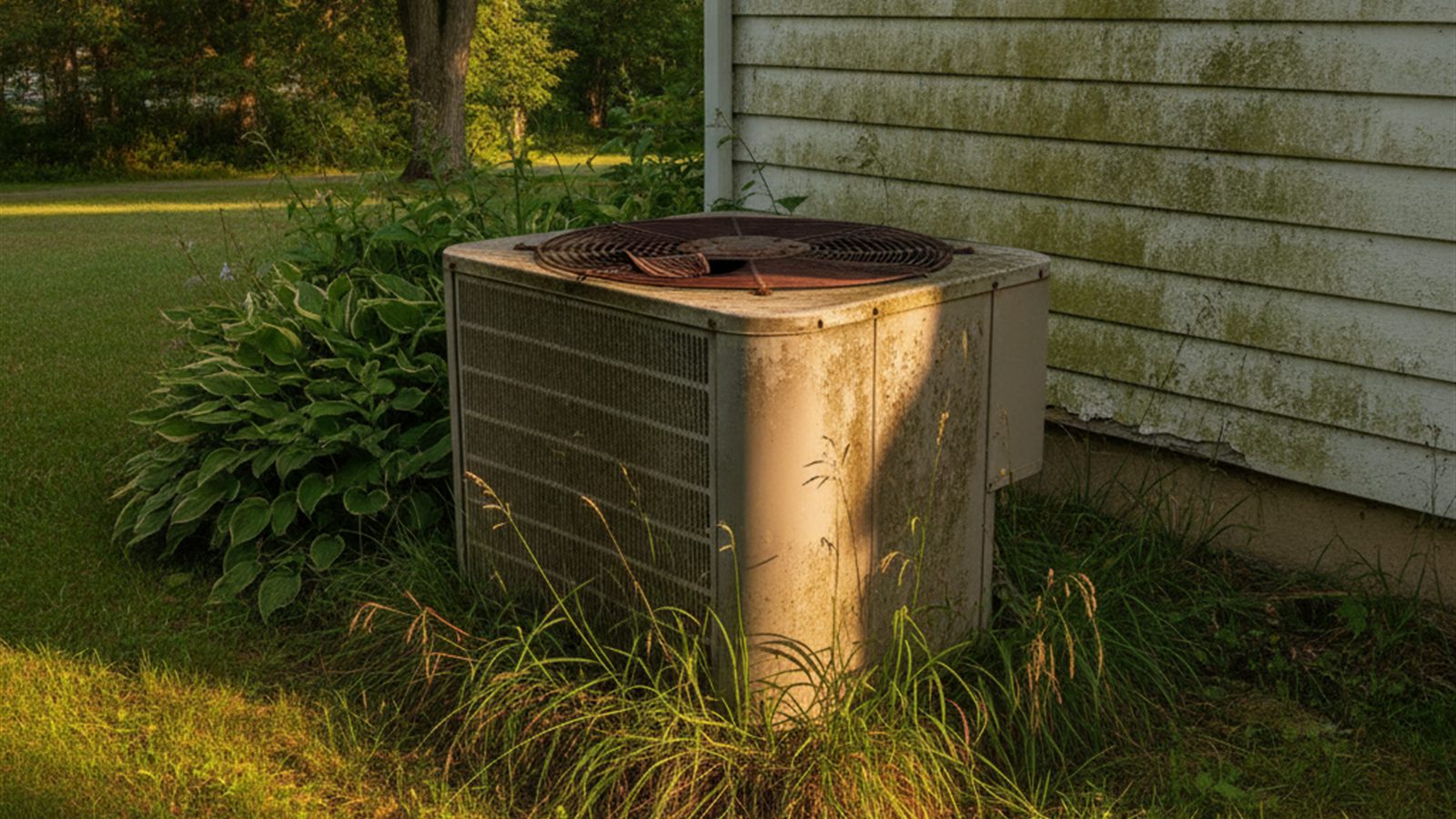
Age sets the frame for everything that follows, and most homeowners do not know the figure. It is on the data plate attached to the outdoor unit, and where the year is not printed directly it is usually encoded in the first four digits of the serial number as week and year of manufacture.
A central air conditioner in this region typically gives fifteen to twenty years of service. Systems that have been maintained annually sit at the upper end. Systems that have never been serviced, or that were oversized at installation and have short-cycled ever since, sit well below it.
| System age | Default position | What would change it |
|---|---|---|
| Under 8 years | Repair | Almost nothing. Check warranty coverage first |
| 8 to 12 years | Repair, with judgement on major components | A compressor or coil failure shifts the calculation |
| 12 to 15 years | Compare both options on written quotes | Repair cost above roughly a third of replacement |
| Over 15 years | Price a replacement before spending | A minor repair on an otherwise sound unit is still reasonable |
| Any age on R-22 | Compare immediately if the fault involves refrigerant | A non-refrigerant repair may still be worthwhile |
Reading the Data Plate
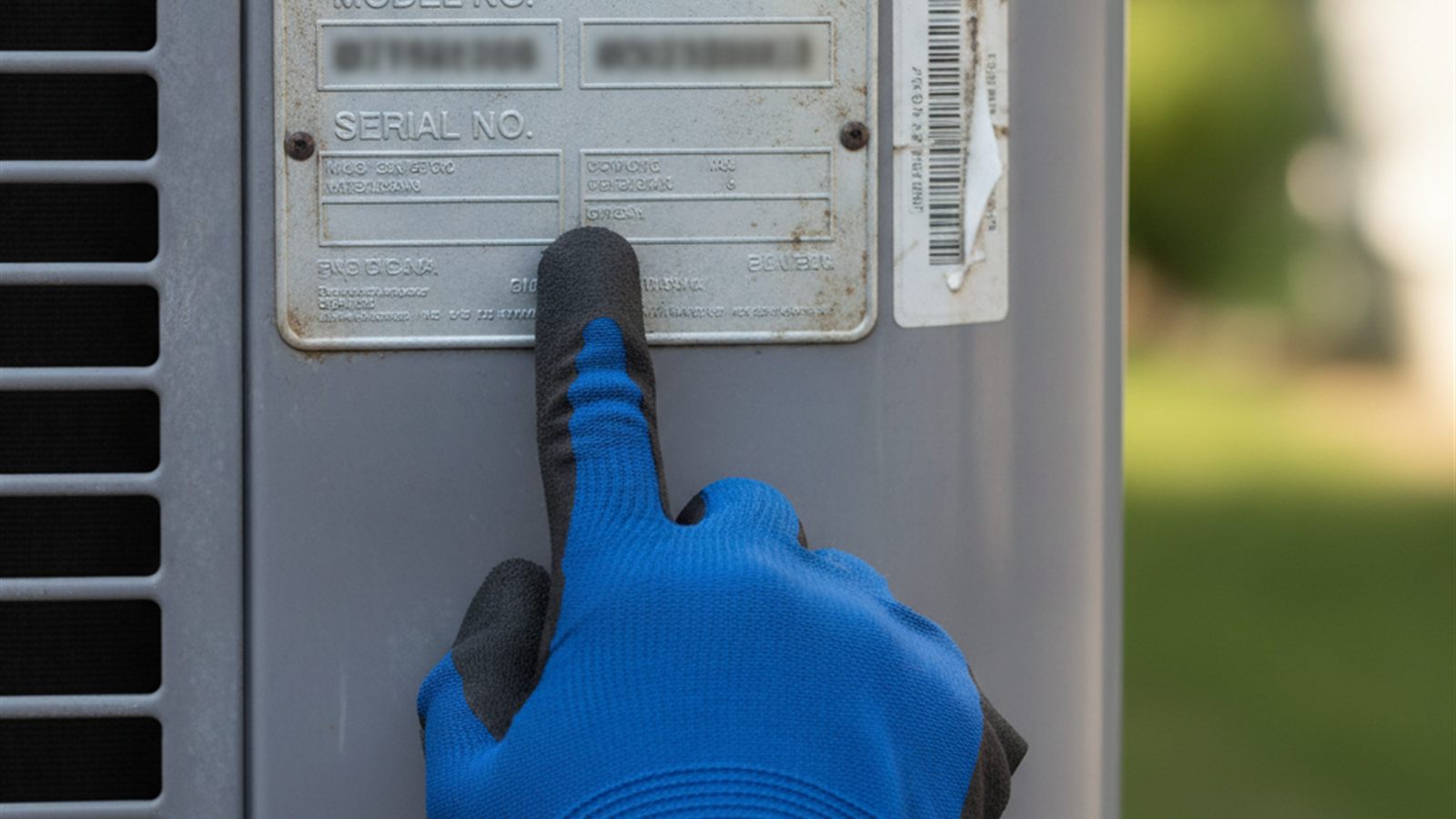
What to record before deciding anything
- Manufacture date, printed or encoded in the serial number
- Refrigerant type, listed as R-22 or R-410A on the plate
- Tonnage or BTU rating, which determines replacement sizing
- SEER rating, useful for comparing running cost against a modern unit
- Repair history, particularly anything in the last three seasons
Sizing is worth flagging at this stage rather than later. If the existing system has never cooled the house properly, or has short-cycled and left rooms uneven, replacing like for like repeats the original error. A replacement should be sized from a load calculation rather than from the label on the old unit, a point covered in more depth in our guide to sizing an air conditioner for a Rochester home.
What Individual Repairs Cost

Repair costs separate into two tiers, and which tier a fault falls into matters more than the age of the system.
| Component | Typical Rochester cost | Tier | Bearing on the decision |
|---|---|---|---|
| Capacitor | $175 – $400 | Minor | Repair at almost any age |
| Contactor | $175 – $375 | Minor | Repair at almost any age |
| Condenser fan motor | $350 – $750 | Moderate | Repair under 12 years |
| Blower motor | $450 – $1,100 | Moderate | Repair under 12 years |
| Refrigerant leak, located and repaired | $300 – $1,500 | Moderate to major | Depends heavily on refrigerant type |
| Evaporator coil | $900 – $2,800 | Major | Compare against replacement over 12 years |
| Condenser coil | $1,000 – $2,500 | Major | Compare against replacement over 12 years |
| Compressor | $1,500 – $3,200 | Major | Rarely economic out of warranty |
The pattern in that table is the useful part. Minor-tier faults are worth repairing on almost any system that is otherwise sound, which is why a replacement quotation for a unit that only needs a capacitor should be questioned. Major-tier faults on equipment past twelve years are where the comparison genuinely opens up. Our full AC repair pricing in Rochester, NY follows the same tiering.
What Replacement Costs
Replacement pricing depends on capacity, efficiency rating and how much of the existing system is being retained.
| Scope of work | Typical Rochester cost | When this applies |
|---|---|---|
| Condenser only, matched to existing coil | $3,200 – $5,500 | Rarely advisable, mismatched systems lose efficiency |
| Condenser and evaporator coil, standard efficiency | $4,500 – $8,500 | Furnace in good condition and staying |
| Condenser and coil, high efficiency | $6,500 – $11,000 | Long-term ownership, higher run hours |
| Full system, AC and furnace together | $8,000 – $14,000 | Both units at end of life |
| Changeover to a heat pump | $10,000 – $20,000 before rebates | Replaces heating and cooling in one system |
The first row is included because it gets quoted and it is usually a false economy. Pairing a new condenser to an ageing coil that was matched to different equipment gives up a meaningful share of the rated efficiency and leaves the older component to fail on its own timetable.
Applying the Decision Rule
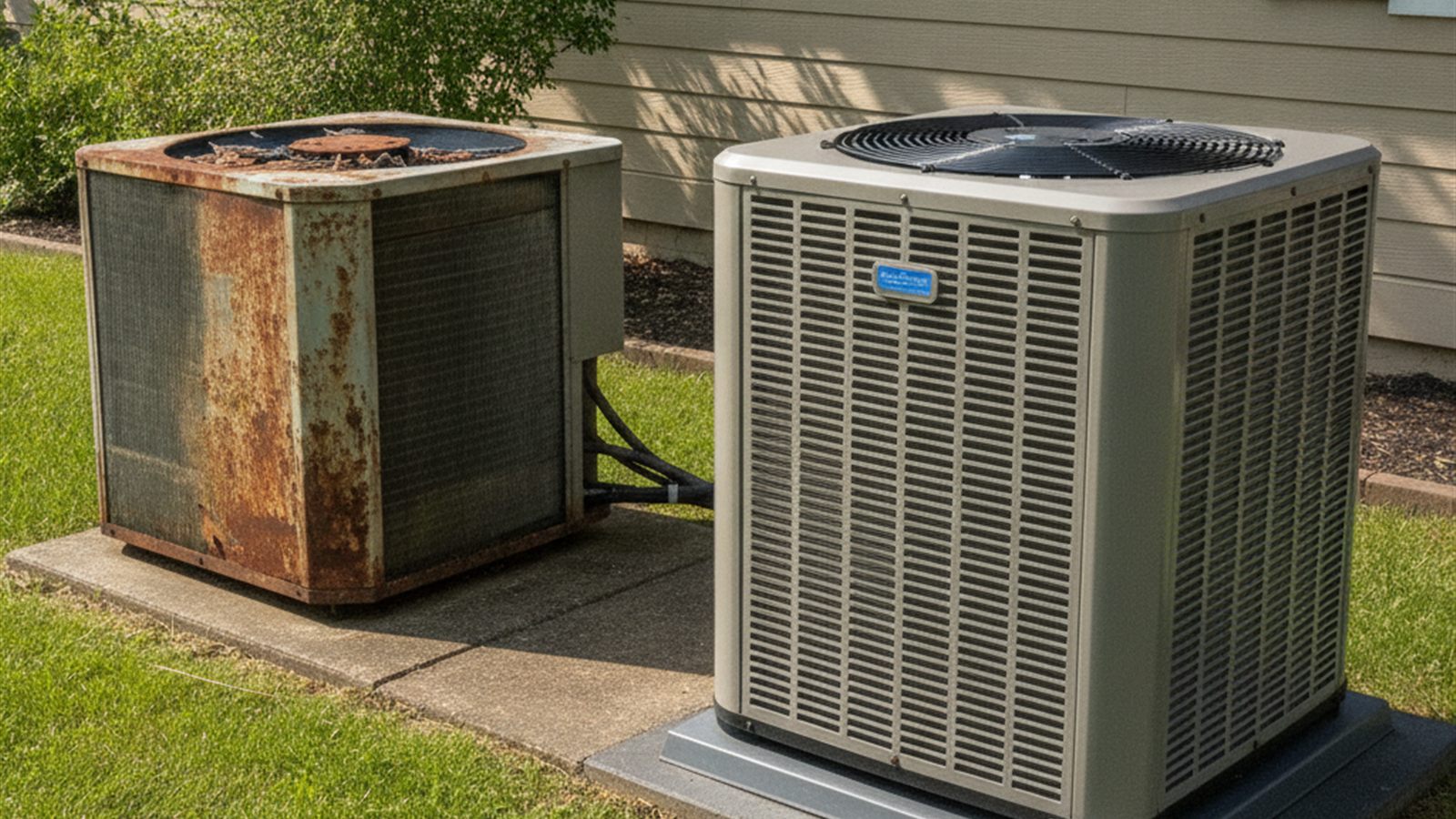
A workable rule multiplies the repair cost by the age of the system in years. Where that figure exceeds the cost of replacement, replacement is the better allocation. A $600 repair on a five-year-old unit gives $3,000, comfortably below replacement, so the repair is correct. The same $600 repair on a sixteen-year-old unit gives $9,600, which is above the cost of most replacements.
It is a guide rather than an arithmetic instruction, and three factors override it.
| Situation | Overrides toward | Reason |
|---|---|---|
| Repair is covered by an active warranty | Repair | The cost comparison no longer applies |
| System runs on R-22 and the fault involves refrigerant | Replace | Refrigerant cost alone can exceed the repair value |
| Furnace is also near end of life | Replace both | Combined installation is materially cheaper than two separate visits |
| Two or more repairs in the last two seasons | Replace | Component failures are clustering |
| Selling the property within a year | Repair | Replacement rarely returns its cost at sale |
| Home was never cooled adequately | Replace, resized | Repairing preserves an existing sizing error |
The R-22 Question
Any system manufactured before roughly 2010 is likely to run on R-22, and this single fact changes the arithmetic more than any other.
R-22 production and import ceased in the United States in 2020 under the EPA phaseout of ozone-depleting refrigerants. Servicing now depends entirely on reclaimed and stockpiled supply, and the price reflects that scarcity. A recharge that would be routine on an R-410A system becomes a substantial line item on an R-22 one.
The practical position is straightforward. On an R-22 system, a repair that does not involve opening the refrigerant circuit, such as a capacitor, contactor or fan motor, is usually still worth doing. A repair that requires recovering and recharging the system, particularly a leak repair or a coil replacement, rarely is. At that point the money is better directed at equipment that can be serviced normally for the next fifteen years.
What Changes the Calculation Locally
Two Rochester-specific factors shift the comparison, and both favour replacement more than homeowners expect.
Local factors worth pricing in
- Combined replacement economics. Where the furnace is also ageing, replacing both together avoids a second installation charge and a second set of connections. The saving against two separate jobs is typically several thousand dollars
- Heat pump incentives. Changing from separate AC and furnace to a heat pump brings NYS Clean Heat, utility and federal incentives into play, none of which apply to a straight AC replacement
- Short cooling season. Rochester runs roughly three months of meaningful cooling load, so efficiency upgrades pay back more slowly here than in southern markets. That argues against paying a premium for the highest SEER tier on cooling alone
- Shoulder-season scheduling. Replacement work booked in May or September is easier to schedule than in a July heat wave, when availability across the region tightens
The rebate point is the one most often missed. A homeowner comparing a $2,400 coil repair against a $7,000 AC replacement may reach a different conclusion once a heat pump changeover with incentives applied enters the comparison. Current programmes are summarised on our Rochester HVAC rebates and savings page.
Getting a Straight Answer
What to ask for before agreeing to either option
- The repair quoted in writing, itemised for parts and labour
- The replacement quoted in writing, with rebates broken out separately
- The specific fault identified, not a general statement that the system is old
- The manufacture date and refrigerant type confirmed from the data plate
- For a replacement, the load calculation used to size the equipment
- Whether the existing coil, line set and furnace are being retained or replaced
Any contractor should be willing to provide both figures. Where a replacement is recommended without a repair estimate to compare against, that is worth a second opinion. We quote AC replacement in Rochester, NY alongside the repair option as a matter of course, including in the older properties around Pittsford where ductwork condition frequently affects which route makes sense.
“Great work from the whole team installing a new AC unit.”
Jenny Robinson ★★★★★
Google review, AC replacement
Not Sure Whether to Repair or Replace?
Tell us the age of the system and what has failed and we will give you both figures. If the repair is the sensible route we will say so, and we will tell you how many seasons it is likely to buy.
Family-owned Rochester HVAC since 1989, free over the phone, free in-home proposals, no upsell.
Frequently Asked Questions
Select a question to view the answer
How long does an AC unit last?
Fifteen to twenty years is typical for central air conditioning in this region. Annually serviced systems sit at the upper end. Systems never serviced, or oversized at installation so that they short-cycle, sit well below it. Run hours matter more than calendar age, which is why Rochester’s relatively short cooling season tends to favour longer service life than southern markets.
When is it not worth repairing an air conditioner?
A workable rule multiplies the repair cost by the age of the system in years. Where that figure exceeds the cost of replacement, replacement is the better allocation. A compressor or coil failure on a system past fifteen years rarely justifies the spend, and neither does a refrigerant circuit repair on an R-22 system at any age.
How much does AC unit replacement cost?
In the Rochester area a condenser and evaporator coil at standard efficiency typically runs $4,500 to $8,500, and a high-efficiency pairing $6,500 to $11,000. Replacing the air conditioning and furnace together runs $8,000 to $14,000, which is materially less than two separate installations. A heat pump changeover runs $10,000 to $20,000 before rebates.
Is it worth replacing an AC compressor?
Rarely, once the warranty has expired. A compressor runs $1,500 to $3,200 fitted, which is a substantial share of a full replacement, and it is being installed into a system whose remaining components are the same age. Where the compressor is still under manufacturer warranty and only labour is chargeable, the position reverses and the repair usually makes sense.
Should I replace the furnace at the same time as the AC?
Where both are ageing, yes. The evaporator coil sits on the furnace in most Rochester homes and the two share ductwork and connections, so a combined installation avoids a second labour charge and a second disruption. The saving against two separate jobs is typically several thousand dollars. Where the furnace was replaced recently, there is no reason to disturb it.
How do I find out how old my AC unit is?
The data plate on the outdoor unit carries it. Where the manufacture date is not printed directly, it is generally encoded in the first four digits of the serial number as week and year. The same plate lists the refrigerant type, which is the other figure that matters, since an R-22 system faces different economics to an R-410A one.
Dalton Heating & Cooling
1556 Brace Rd, Victor, NY 14564
Office hours: Mon to Fri, 8:00 AM to 4:30 PM
Emergency service: 24/7 by phone