
Water pooling around an indoor air handler or furnace cabinet is one of the more common cooling-season service calls we take across Greater Rochester. It is also one of the most misdiagnosed, because the water usually appears somewhere other than where the fault is.
In most cases the cause is straightforward. A blocked condensate drain accounts for the majority of these calls, and it is a routine repair rather than a failed system. The more expensive causes exist, but they are the minority, and there are clear signs that separate one from the other.
This guide covers what produces the water, how to identify the cause from what you are seeing, what you can safely resolve yourself, what the repairs cost in the Rochester area, and the point at which the system should be looked at professionally.
From Darren, the owner
The mistake I see most is people mopping up the water and continuing to run the system. The water is a symptom. If the coil has frozen and the system keeps running, a $200 repair becomes a compressor replacement. Shut it down, let it thaw, then establish the cause.
Shut the System Down First
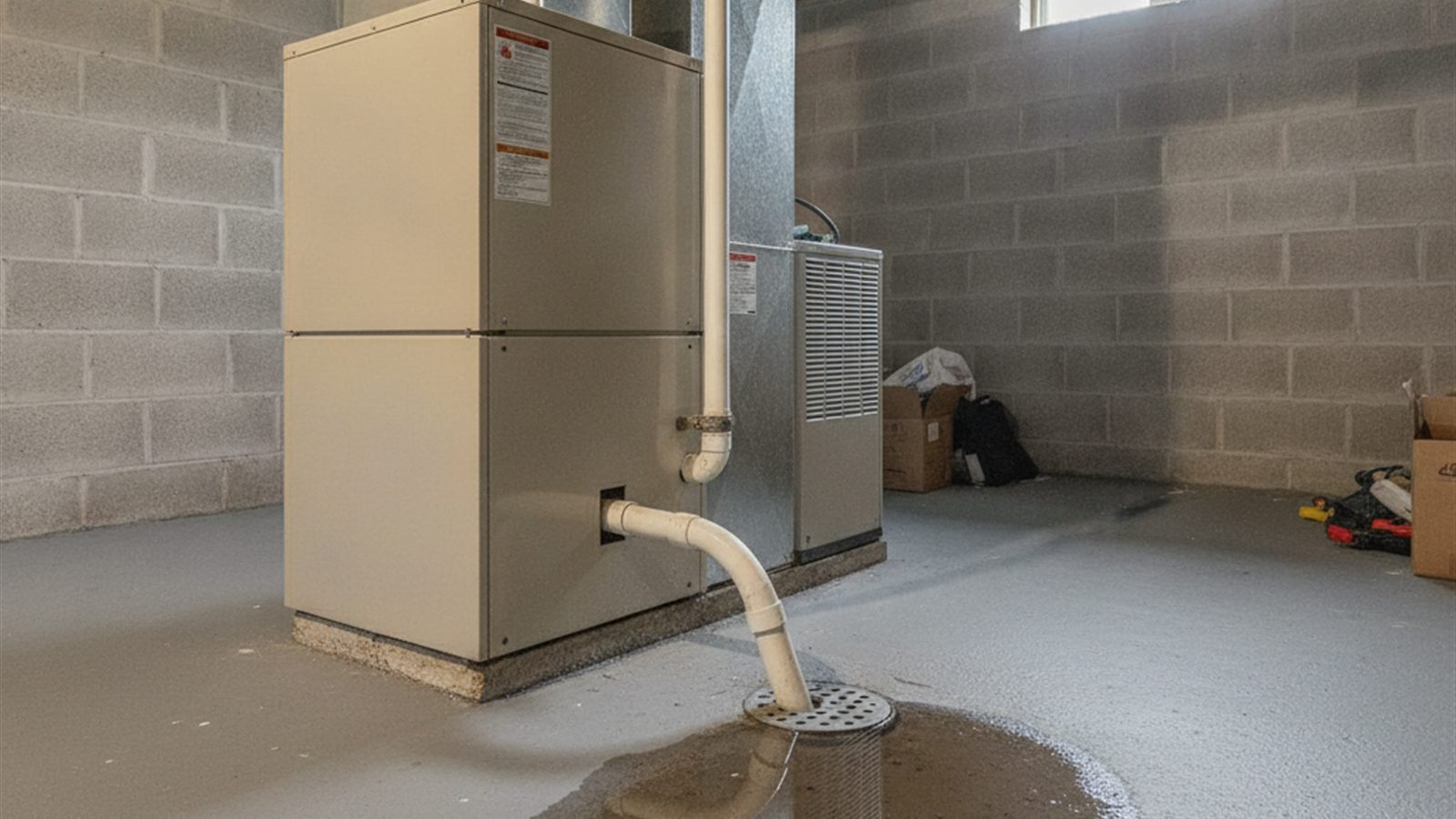
Before investigating, switch the cooling off at the thermostat. Set it to OFF rather than raising the temperature, and leave the fan on AUTO.
There are two reasons for this. If the leak originates from a frozen evaporator coil, continued operation builds further ice and places the compressor under load it was not designed to carry. That is the single most common way an inexpensive repair becomes a costly one. Separately, water travelling near the electrical section of the air handler should be dealt with on a de-energised system.
Immediate steps
- Set the thermostat to OFF, fan to AUTO
- Remove standing water and place a tray or towel under the drip
- If water has reached a ceiling below, position a bucket and allow the drywall to dry
- Photograph where the water is emerging before you clean up, which shortens the diagnosis
Standing water against drywall or subfloor becomes a secondary problem quickly. The EPA notes that mould growth can begin within 24 to 48 hours of materials becoming wet, so drying the affected area matters as much as fixing the leak.
Why an Air Conditioner Produces Water at All
Understanding this narrows the diagnosis considerably, because it establishes that the water is normal and only its route has changed.
Air conditioning performs two functions simultaneously. It lowers air temperature, and it removes moisture. Warm humid air passes across a cold evaporator coil and the moisture in that air condenses on the coil surface. On a humid Rochester afternoon a typical residential system removes somewhere between five and twenty gallons of water from the air in a day.
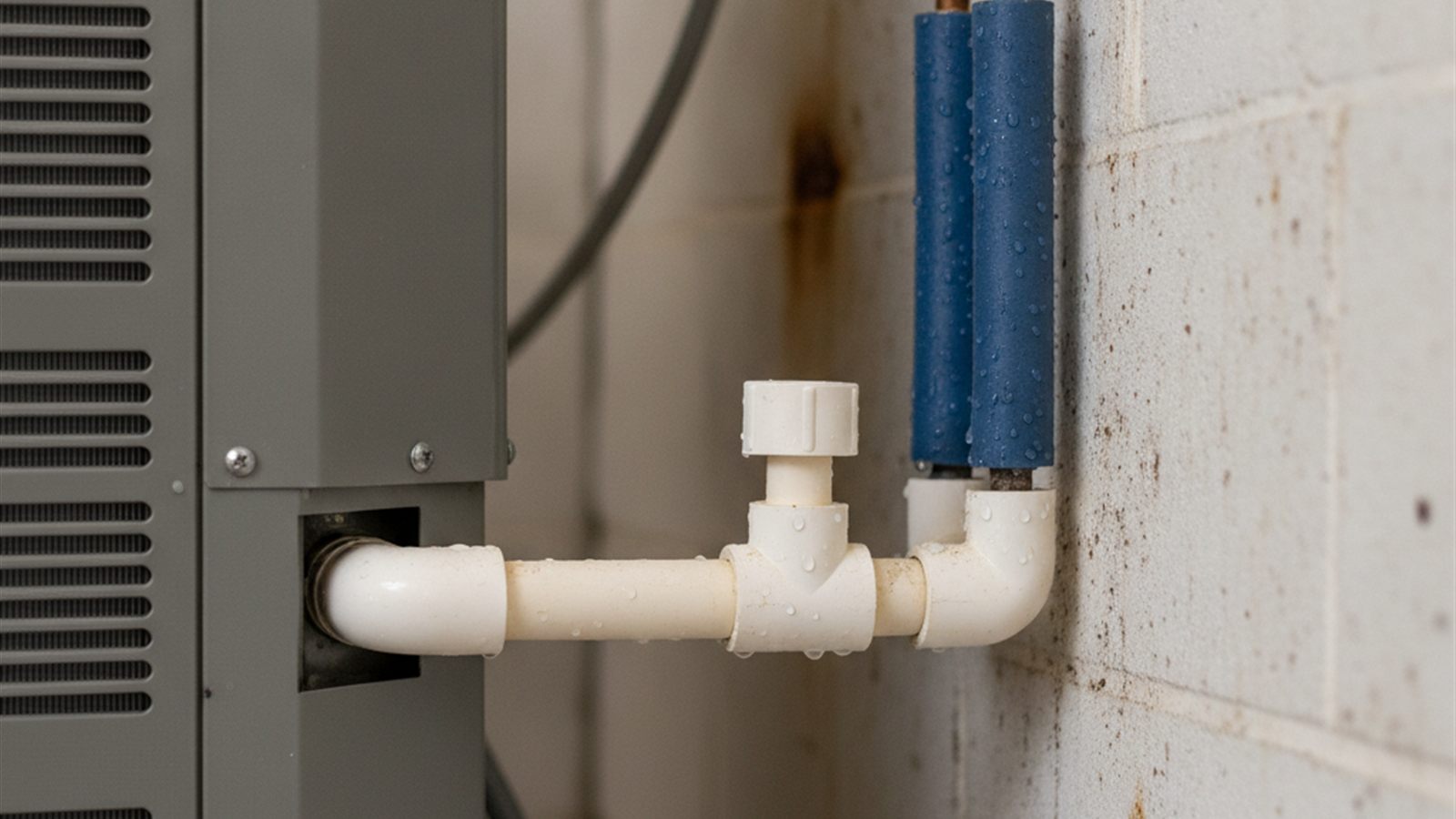
That condensate collects in a drain pan beneath the coil and leaves through a condensate drain line, normally white PVC, terminating at a floor drain, a condensate pump, or outside through the foundation wall.
The system therefore produces water continuously throughout the cooling season. A leak rarely indicates a new source of water. It indicates that the established drainage path has been interrupted, which is why the investigation should begin at the drain rather than the equipment.
Identifying the Cause From the Symptom
The pattern of the leak identifies the cause more reliably than its volume. The table below covers the six causes that account for nearly all residential condensate leaks.
| What you are seeing | Most likely cause | Homeowner or technician |
|---|---|---|
| Steady leak at the base of the indoor unit, worse on humid days | Clogged condensate drain line | Homeowner |
| Intermittent leak, sudden volume after the system cycles off | Frozen evaporator coil | Both, see below |
| Consistent leak regardless of humidity, drain line running clear | Cracked or rusted drain pan | Technician |
| Leak appeared after unrelated work near the equipment | Disconnected or sagging drain line | Homeowner |
| Leak alongside reduced airflow at the vents | Restricted air filter causing coil freeze | Homeowner |
| Leak alongside poor cooling and ice on the copper lines | Low refrigerant charge | Technician |
The first row accounts for the largest share. The drain line is dark, permanently damp and carries a slow flow of water all summer, which makes it a favourable environment for algae and biological slime. Dust drawn through the return adds to the deposit. Over one or two seasons the internal diameter reduces until the line blocks entirely and the pan overflows.
Three signs that confirm a blocked drain line
- The leak is at the base of the indoor unit rather than elsewhere in the system
- It worsens during humid weather and improves when conditions are dry
- Nothing discharges from the outdoor end of the drain line while the system runs
A refrigerant shortfall belongs in a different category to the others. Refrigerant is not consumed in normal operation, so a low charge means the circuit has a leak. Recharging without locating that leak returns the same fault the following season, usually with additional compressor wear in between.
Confirming a Frozen Evaporator Coil
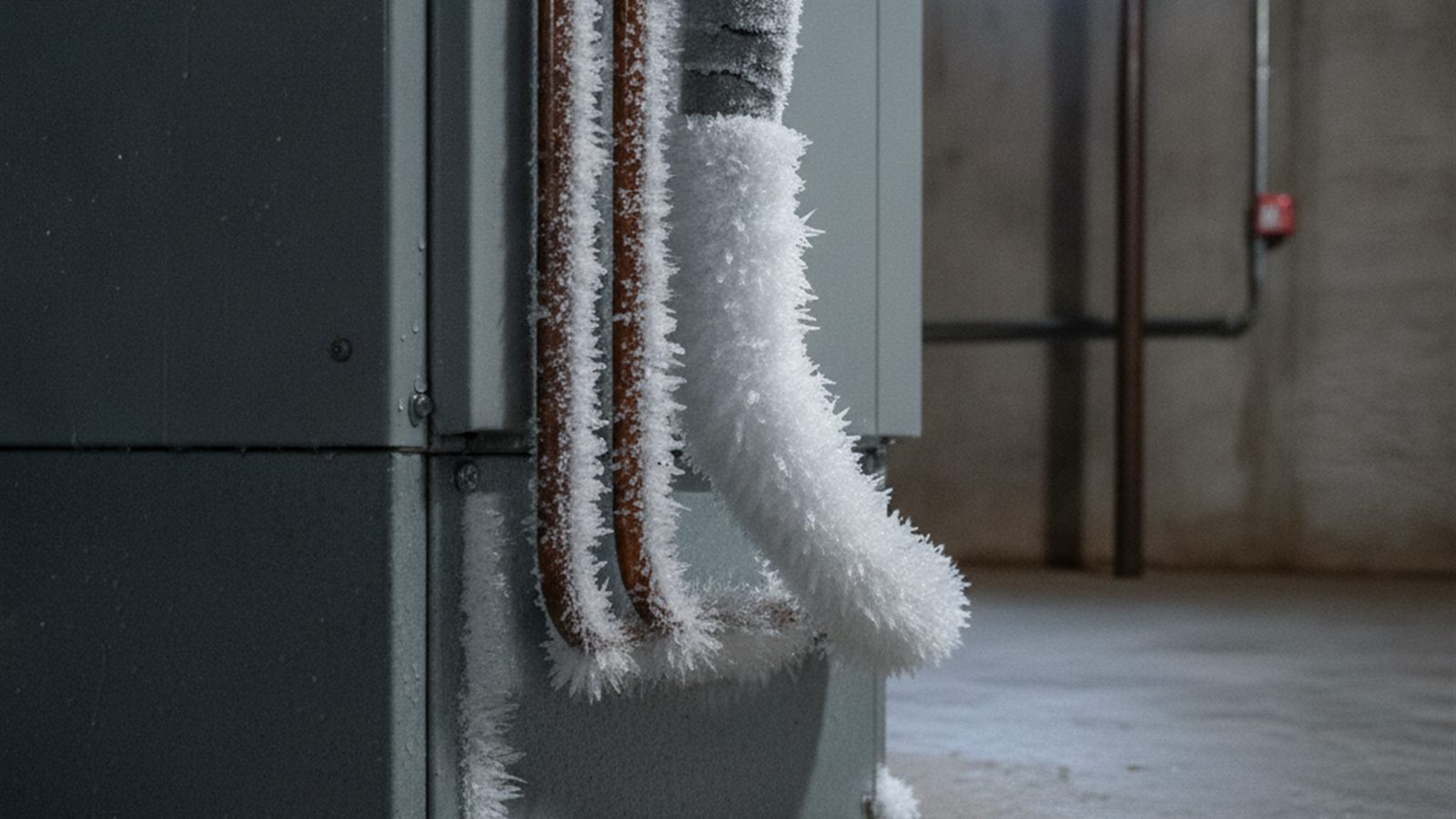
This cause can be confirmed without opening the cabinet. Inspect the copper refrigerant lines where they enter the indoor unit. Frost or ice on the larger insulated line, or visible ice on the coil itself, confirms a freeze. Where the system is also failing to hold temperature, the underlying causes overlap almost entirely with those covered in our guide to an air conditioner that runs without cooling, and the diagnostic sequence is the same.
Thawing procedure
- Switch cooling off at the thermostat and set the fan to ON. Circulating room-temperature air thaws the coil considerably faster than leaving the system idle.
- Allow one to three hours. Heavily iced coils take longer.
- Replace the air filter during the thaw.
- Once fully clear, run the system and observe it. A coil that re-freezes within a day indicates an airflow or refrigerant fault requiring a technician.
Do not attempt to chip the ice away or apply heat directly. Evaporator fins damage easily, and a punctured coil converts a service call into a coil replacement.
Why a Furnace Appears to Leak During Cooling Season
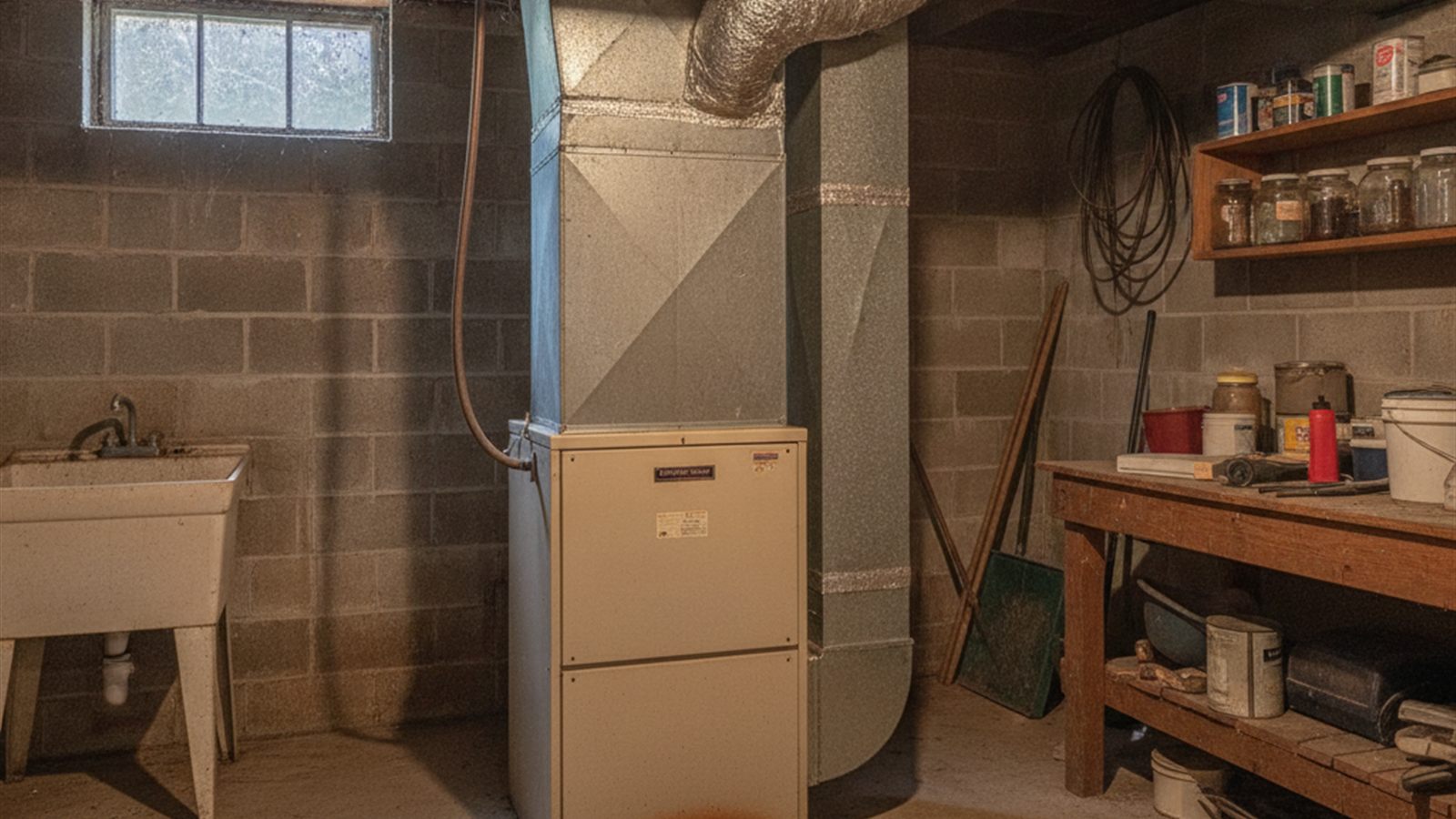
A recurring summer call describes a furnace leaking water in July while the heating is switched off.
In the majority of homes in this region the air conditioning has no separate indoor cabinet. The evaporator coil sits in a sheet metal enclosure directly on top of the furnace, sharing the same blower and ductwork. When that coil or its pan overflows, the water runs down the exterior of the furnace cabinet and collects at its base. The presentation is a leaking furnace. The cause is the cooling system above it.
The consequence is worth taking seriously. Water tracking down a furnace cabinet reaches the control board and the inducer motor, which is the mechanism by which an unresolved drain restriction in August becomes a no-heat call in November. That sequence is most common in the older housing stock we work in around Pittsford, Brighton and the city line, where equipment is frequently installed in confined basement corners and a slow leak can run for weeks before anyone notices it.
Water at the base of a furnace during cooling season should therefore be treated as an air conditioning drainage fault and resolved before the heating season begins.
Clearing a Blocked Condensate Drain Line
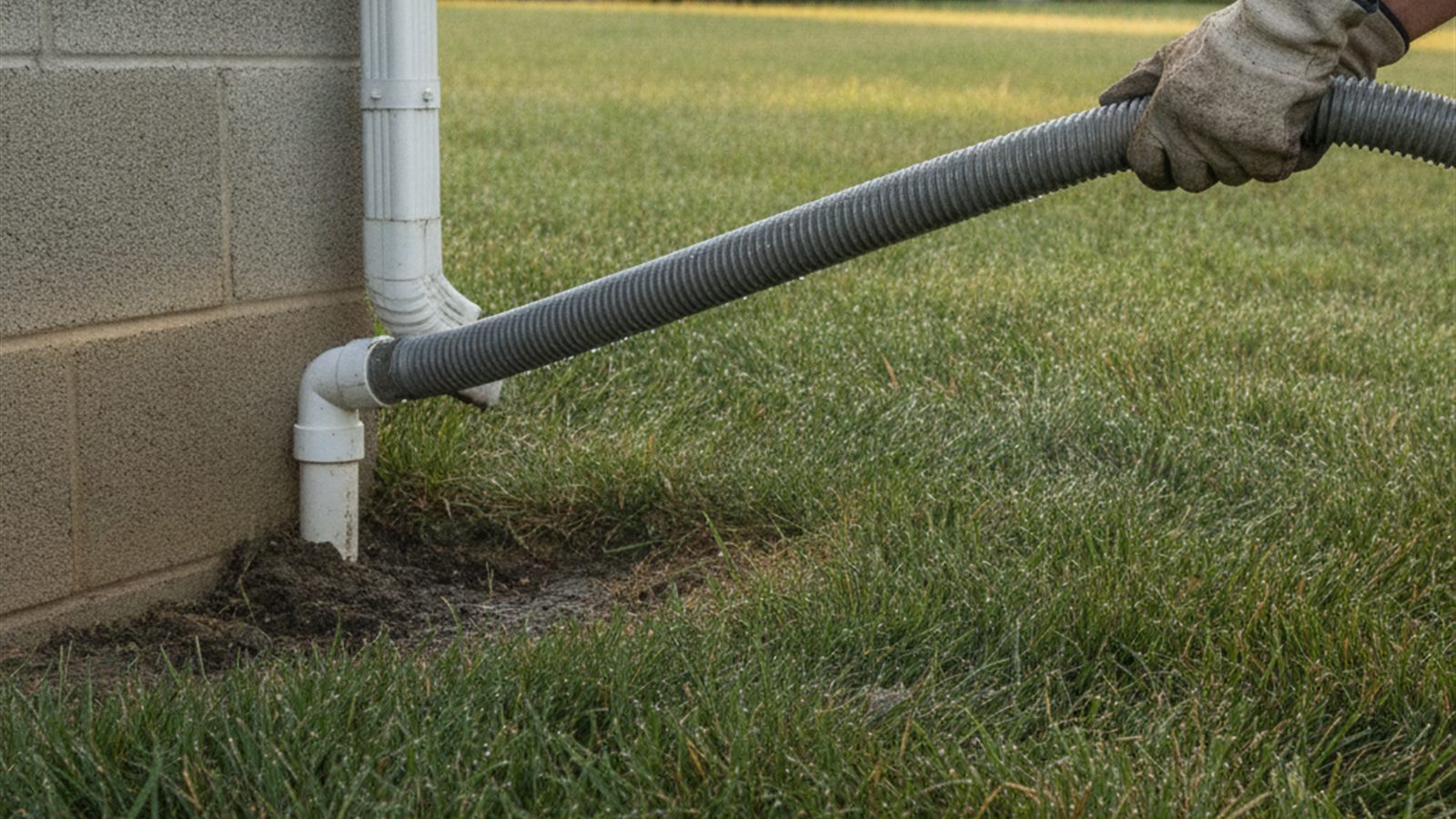
This is within reach of most homeowners with a wet dry vacuum and takes around twenty minutes.
Procedure
- Isolate the system. Switch off at the thermostat and at the service switch beside the air handler, normally a standard light switch on or near the cabinet.
- Locate both ends of the drain line. White PVC, typically three quarters of an inch. One end leaves the indoor unit; the other terminates at a floor drain, a condensate pump, or outside at the foundation.
- Apply the vacuum to the outdoor termination. Seal around the hose with a rag and run it for two to three minutes. Most restrictions clear at this stage and the release is usually audible.
- Locate the access tee. A T-shaped fitting with a removable cap sits near the indoor unit. Remove the cap.
- Flush the line. Pour approximately one cup of distilled white vinegar into the access tee. Leave for thirty minutes, then follow with a slow pour of warm water and confirm free discharge at the far end.
- Reinstate. Replace the cap, restore power, run the system for an hour and check for further discharge.
Bleach should not be used for this. It is widely recommended online, and it corrodes metal drain pans and any soldered joints it contacts. Vinegar achieves the same result without the damage.
Repeating the vinegar flush each spring prevents recurrence. Clearing and treating the condensate line is a standard item within an annual AC tune-up, which is why homes on a maintenance schedule rarely generate this call at all.
Water at a Vent, a Window Unit or a Ceiling
Water appearing away from the equipment has different causes, and the location identifies which applies.
| Where the water appears | Cause | Resolution |
|---|---|---|
| Dripping from a ceiling or wall register | Condensation forming on uninsulated ductwork in a hot attic or crawlspace | Insulate and seal the duct run |
| Staining on a ceiling below an attic air handler | Overflowing secondary drain pan, or a blocked secondary drain | Technician, the primary drain has already failed |
| Inside the room at a window unit | Unit mounted level or tilted inward instead of draining outward | Adjust the tilt, clear the base pan drain hole |
| Outside at the condenser on a humid day | Normal condensate discharge | No action required |
The second row deserves particular attention. Where an air handler is installed in an attic or crawlspace, as it is in many of the ranch and split-level properties we service around Henrietta, the secondary pan is the last line of defence. Water reaching a ceiling from that position means the primary drain has already blocked and the backup is now full.
Repair Costs in the Rochester Area
Exact pricing depends on the cause and the equipment, and the cost is confirmed before any work begins. The ranges below are typical for this area.
| Repair | Typical Rochester cost | Frequency |
|---|---|---|
| Diagnostic visit, credited against the repair | $95 – $175 | Every call |
| Clearing a clogged condensate drain line | $125 – $250 | Most common |
| Condensate pump replacement | $150 – $400 | Occasional |
| Drain pan replacement | $250 – $600 | Older systems |
| Refrigerant leak location and repair | $300 – $1,500 | Less common |
| Evaporator coil replacement | $900 – $2,800 | Least common |
The distribution is the point worth noting. The most frequent cause is also the least expensive to resolve. Where a system is leaking but otherwise cooling normally, a quotation for coil replacement or full system replacement warrants a second opinion before proceeding, and the diagnostic sequence behind our AC repair pricing in Rochester, NY follows the same order of elimination set out above.
When the System Needs a Technician
Stop and call if any of the following apply
- The coil re-freezes within a day of thawing
- The leak continues after the drain line is confirmed clear
- The drain pan shows rust, cracking or standing water
- Water has reached the furnace controls or any electrical component
- Cooling performance has dropped alongside the leak
- There is an odour of mould, or water has been present long enough to mark drywall
We cover Victor, Pittsford, Fairport, Penfield, Honeoye Falls, Canandaigua, Farmington, Mendon, Brighton, Chili and Churchville, and carry the common condensate and control parts on the vehicles, so the majority of these calls are completed on the first visit.
“Tech was able to come out much faster than anyone else during a hot spell. He was here less than an hour and was able to fix air conditioning. He explained the problem and was very knowledgeable. They were very reasonable compared to the last company I had used.”
Cindy Mahoney ★★★★★
Google review, AC repair during a heat wave
Unresolved Leak, or Not Sure of the Cause?
Describe what you are seeing and we will tell you whether it is a drain line you can clear yourself or a fault that needs attention. Emergency cover runs 24/7 through the cooling season.
Family-owned Rochester HVAC since 1989, free over the phone, free in-home proposals, no upsell.
Frequently Asked Questions
Select a question to view the answer
Is it dangerous if my AC is leaking water inside the house?
The water itself is condensate, so it is not hazardous to touch. The risks are secondary. Water reaching electrical components in the air handler or furnace can cause a fault, and standing water against drywall or subfloor can begin growing mould within a couple of days. It is not an emergency in the way a gas odour is, but it should not be left for weeks.
Can I still run my AC if it is leaking water?
Not until the cause is established. If the coil has frozen, continued operation worsens the ice and places the compressor at risk, which is the difference between a $200 repair and a $2,000 one. Where the fault is confirmed as a slow drain restriction and a tray is catching the water, brief operation is unlikely to cause damage, but the line should be cleared first.
How do I know if my condensate drain line is clogged?
Three signs point to it. The leak is at the base of the indoor unit rather than elsewhere. It worsens on humid days and improves in dry weather. And nothing discharges from the outdoor end of the drain line while the system runs. A drain pan full to the brim with clear water is close to conclusive.
Why is water dripping from my AC vent?
That is usually condensation forming on the outside of uninsulated ductwork running through a hot attic or crawlspace, rather than a drainage fault at the unit. Humid air meets cold duct metal, condenses, runs along the duct and discharges at the nearest register. The resolution is insulating and sealing the duct rather than any work at the air handler.
How much does it cost to fix an AC that is leaking water?
Clearing a clogged drain line in the Rochester area typically runs $125 to $250, and a diagnostic visit is $95 to $175 credited against the repair. A condensate pump is $150 to $400 and a drain pan $250 to $600. The higher-cost outcomes are a refrigerant leak at $300 to $1,500 or an evaporator coil at $900 to $2,800, though those account for the minority of leak calls.
How often should the AC drain line be cleaned?
Once a year is sufficient for most Rochester homes, carried out in spring before the cooling season begins. A cup of distilled white vinegar into the access tee takes a few minutes. Homes with pets, or systems installed in dusty basements, benefit from twice yearly treatment. It is included within an annual tune-up.
Dalton Heating & Cooling
1556 Brace Rd, Victor, NY 14564
Office hours: Mon to Fri, 8:00 AM to 4:30 PM
Emergency service: 24/7 by phone